How Much Does a Dental Checkup Cost in Mississauga

How Much Does a Dental Checkup Cost in Mississauga

Booking a checkup shouldn't mean guessing what the bill will look like. Here's what actually drives the price.

A lot of people put off visiting the dentist simply because they're not sure what a checkup will cost or what they're actually paying for. Dental checkup cost in Mississauga depends on what your visit includes. Most clinics bundle a few services into one appointment rather than billing each step separately and whether you're covered under CDCP, private insurance or paying out of pocket changes your final number too. There isn't one flat rate across Ontario, since every clinic sets its own fees, but understanding what goes into a checkup helps you know roughly what to expect before you book.

What Will a Dental Checkup Actually Cost Me?

A routine checkup in Ontario, including an exam, cleaning and basic X-rays, generally falls between $150 and $350 without coverage, though every clinic sets its own fees. CDCP-eligible patients with income under $70,000 pay no co-payment on covered services; those between $70,000 and $89,999 pay a 40% or 60% co-payment. Confirm your exact cost when you book.

What's Actually Included in a Dental Checkup?

A checkup is a bundled appointment, not one single fee. Most visits group these pieces together:
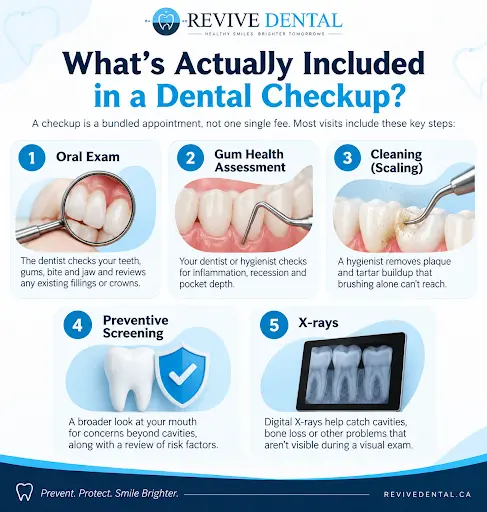
  • Oral exam. The dentist checks your teeth, gums, bite and jaw and reviews any existing fillings or crowns to make sure they're holding up.
  • Gum health assessment. Gum disease often develops quietly. Catching it at the gingivitis stage matters, since that's the one stage that can fully reverse with treatment. Your dentist or hygienist checks for inflammation, recession and pocket depth as part of a routine exam.
  • Cleaning (scaling). A hygienist removes plaque and tartar buildup that brushing alone can't reach.
  • Preventive screening. Many checkups also include a broader look at your mouth for concerns beyond cavities, along with a quick review of risk factors like grinding or smoking.
  • X-rays. Digital X-rays help catch cavities, bone loss or other problems that aren't visible during a visual exam.

New patient visits typically cost more than a returning patient's regular six-month checkup, since a first visit usually includes a more thorough review of dental history and often a full set of X-rays.

What Does the Average Cost for Dental Cleaning and Checkup Look Like?

Because every clinic in Ontario sets its own fees, there's no single number that applies everywhere. The Ontario Dental Association publishes a suggested fee guide dentists can reference, but the association itself is clear that it's only a reference point. Dentists aren't required to follow it and fees vary based on the dentist, the clinic's location and what your specific visit requires.

That said, published Ontario-wide figures give a general sense of range:

These are general Ontario ranges, not a quote for any specific clinic. The exact dental checkup without insurance cost at Revive Dental Clinic depends on what your visit includes, so the most accurate way to know your number is to call and ask before you book.

How Do X-Rays Affect the Total Cost?

X-rays aren't needed at every visit, but they play an important role in catching problems a visual exam can't. In Ontario, digital X-rays typically add somewhere in the range of $30 to $70 per image, depending on the type and how many are needed. Bitewing X-rays, which check for cavities between teeth, are the most common for a routine checkup.

X-rays help detect:

  • Cavities forming between teeth
  • Bone loss from gum disease
  • Infections below the gumline
  • Impacted or unerupted teeth

Patients with a stable dental history and no recent issues often need X-rays less frequently, sometimes only every one to two years, which helps keep long-term costs down.

Why Does the Price Change From One Visit to the Next?

Prices don't just vary between clinics. They can vary between your own visits too, even at the same office. Factors that shift the cost include:

  • Time since your last visit. More buildup after a longer gap usually means a longer, costlier cleaning.
  • Gum health. Early gum disease may need a more involved dental cleaning than a routine polish.
  • Diagnostic needs. Whether X-rays are due this visit or were already taken recently.
  • Preventive add-ons. Fluoride treatment, for example, is sometimes recommended and billed separately.

Patients who keep up with regular checkups typically need shorter cleanings and fewer diagnostics over time, which tends to keep their costs more predictable.

How Does CDCP Change What I Pay?

For CDCP-eligible patients, the co-payment structure is set by the federal program itself, not by individual clinics. Here's how it works:

Exams, X-rays and cleanings fall under diagnostic and preventive services, which the plan covers and most don't require pre-authorization. If a clinic's usual fee is higher than what CDCP covers for that service, you may also owe the difference, known as balance billing. Revive Dental Clinic accepts CDCP and our team can walk you through what a specific appointment will cost once your eligibility is confirmed.

What About Private Insurance?

Most private dental plans in Ontario include some coverage for preventive visits, typically one or two exams per year, cleanings based on time units and X-rays at set intervals. Coverage percentages and annual maximums vary a lot by plan, so some patients still pay a portion out of pocket depending on remaining benefits. Bringing your plan details to your appointment lets the front desk give you a clearer estimate before treatment starts.

What If I Don't Have Insurance or CDCP?

Not having coverage doesn't mean dental care is out of reach. Routine checkups are still one of the most cost-effective parts of healthcare, since:

  • You know the price upfront, without waiting on a claims process
  • Preventive visits catch small problems while they're still cheap to fix
  • Skipping checkups to save money now often leads to pricier treatment later, like fillings, root canals or extractions

These steps help manage symptoms and lower your risk going forward, but they don't address an underlying cavity or crack, which is why persistent sensitivity still needs an exam.

How Often Should I Book a Checkup?

Most adults benefit from a checkup every six months, though your dentist may recommend a different interval based on your oral health. Patients with a stable, low-risk history sometimes stretch to longer gaps between visits, while those with gum concerns or a history of cavities may need to come in more often. If it's been a while since your last visit, booking sooner rather than later usually means a simpler, less costly appointment than waiting until something hurts.

What Should I Ask Before Booking?

A few questions upfront can save confusion later:

  1. Does this price include X-rays or are they billed separately?
  2. Am I being quoted as a new patient or a returning patient?
  3. If I'm CDCP-eligible, what will my co-payment be for this specific visit?
  4. Is there anything that could add to the cost once the dentist examines me?

Skipping regular checkups because the cost feels uncertain often ends up costing more later, since small issues caught early are almost always less expensive to treat than problems that have had time to grow. If you're due for a visit, reach out to a dentist in Mississauga at Revive Dental Clinic to get a clear answer on what your specific appointment will cost or visit our dental cleaning page to see what a routine visit includes.

Frequently Asked Questions About Dental Checkup Costs

1. How much does a dental checkup cost in Mississauga?

A routine checkup that includes an exam, cleaning and basic X-rays typically falls between $150 and $350 in Ontario without coverage, though exact fees vary by clinic. Contact your dental office directly for a specific quote based on your visit.

2. What's the average cost for dental cleaning and checkup together?

When billed together, a routine exam and cleaning without X-rays often runs somewhere between $150 and $260, depending on how much time the cleaning requires. Adding X-rays, common for new patients or annual visits, can bring the total closer to $350.

3. How much does a dental checkup cost without insurance?

Without insurance or CDCP coverage, you pay the clinic's full fee out of pocket, which varies based on what the visit includes and how much time the cleaning takes. Asking for a written estimate before your appointment is the most reliable way to know your exact cost.

4. Are dental cleanings always included in a checkup?

Most routine checkups bundle in a cleaning, but a deeper cleaning needed for gum disease is often priced separately based on clinical need. Your dentist will let you know before any additional cleaning begins.

5. Can skipping dental checkups actually cost more in the long run?

Yes. Skipping routine checkups often means small issues go undetected until they need more extensive treatment, like a filling turning into a root canal. Regular preventive visits are generally the lower-cost path over time.

Teeth Suddenly Sensitive to Cold? Common Causes and Solutions in Mississauga

Teeth Suddenly Sensitive to Cold? Common Causes and Solutions in Mississauga

A sip of ice water or a bite of cold ice cream shouldn't leave you wincing. When it does, something has changed in your mouth and it's worth figuring out what.

If your teeth are suddenly sensitive to cold, the most common reason is that the protective enamel on your teeth has thinned or your gums have pulled back, exposing the softer layer underneath called dentin. Dentin is packed with tiny tubules that connect directly to the nerve inside your tooth, so cold air, cold drinks or even cold weather can trigger a sharp, short jolt of pain. For Mississauga patients, this is one of the most common concerns our team hears about, especially heading into the colder months.

Why Are My Teeth Suddenly Sensitive to Cold?

Sudden cold sensitivity usually means enamel has worn down or gums have receded, exposing the dentin layer beneath. Common causes include aggressive brushing, teeth grinding, acidic foods, harsh mouthwash, gum recession, a cracked tooth or a cavity. Mild cases often improve with a desensitizing toothpaste; sharp or lasting pain needs a dental exam to rule out decay or a crack.

What Causes Sudden Tooth Sensitivity to Cold?

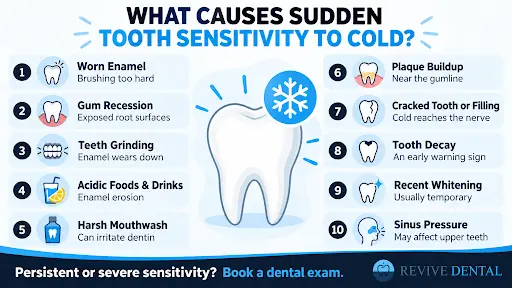
Tooth sensitivity doesn't usually appear overnight without a reason. Something has exposed the dentin layer or irritated the nerve inside the tooth. The most frequent causes we see in our Erindale office include:

  • Worn enamel from brushing too hard. Aggressive brushing, especially with a hard-bristled brush, gradually wears down enamel at the gumline.
  • Gum recession. As gums pull back, the root surface underneath, which has no enamel coating, becomes exposed to temperature and pressure.
  • Teeth grinding (bruxism). Grinding, often during sleep, wears down enamel over time and can make several teeth sensitive at once.
  • Acidic foods and drinks. Citrus, tomatoes, coffee, wine and carbonated drinks gradually soften and erode enamel with repeated exposure.
  • Harsh mouthwash. Some mouthwashes contain acids or high alcohol content that irritate exposed dentin and make sensitivity worse rather than better.
  • Plaque buildup near the gumline. A layer of plaque sitting against the root surface can trigger pain on its own, separate from decay.
  • A cracked tooth or old filling. A hairline crack or a filling that has started to leak lets cold reach the nerve directly, often in just one tooth.
  • Tooth decay. A cavity can expose dentin long before it causes constant pain and cold sensitivity is often the first warning sign.
  • Recent whitening treatment. Whitening products can cause temporary sensitivity that typically settles within a few days.
  • Sinus pressure. Sinus congestion can sometimes cause sensitivity across the upper back teeth that mimics a dental problem.

Is It One Tooth or Are Several Teeth Suddenly Sensitive?

This distinction matters for figuring out what's going on. If teeth are suddenly sensitive to cold air across your whole mouth, the cause is usually something broad, like enamel erosion, grinding, plaque buildup or gum recession. If only one tooth reacts to cold, especially with lingering pain after the cold is gone, that points more toward a cavity, a crack or a problem with a specific tooth's nerve.

Patients sometimes describe this as their bottom front teeth suddenly sensitive or a single tooth in the back reacting sharply to a cold drink while the rest of the mouth feels normal. That pattern is a useful clue for your dentist and worth mentioning at your appointment.

What Is Dentin Hypersensitivity, Exactly?

Dentin hypersensitivity is short, sharp tooth pain that happens when exposed dentin reacts to a stimulus like cold air, cold drinks or sweet foods and then fades once the stimulus is removed. It's one of the most common reasons Mississauga and Erindale patients book an unplanned visit and research on Canadian dental patients suggests dentin hypersensitivity affects roughly 30% of adults between the ages of 18 and 64. It's uncomfortable, but in most cases it's manageable once the underlying cause is identified.

Why are My Teeth Suddenly Sensitive All of a Sudden if Nothing Has Changed?

Patients often say nothing has changed, but enamel wear and gum recession happen gradually over months or years. The sensitivity itself can still feel sudden because it crosses a threshold you notice all at once, often triggered by a change in weather, a new cold drink habit or a recent dental cleaning that removed built-up tartar and exposed a sensitive area underneath. Gum health plays a bigger role here than most people expect. The Canadian Dental Association notes that roughly 7 in 10 Canadians experience some form of gum disease during their lifetime and receding gums from gum disease are a frequent, quiet cause of cold sensitivity.

What Happens if Sensitive Teeth are Left Untreated?

Sensitivity itself isn't dangerous, but ignoring the underlying cause can let a smaller problem grow into a bigger one. Left unaddressed, the issues behind sudden sensitivity can lead to:

  • A cavity progressing until it reaches the nerve and requires more extensive treatment
  • Gum disease advancing and affecting the bone that supports your teeth
  • A small crack spreading further into the tooth
  • Pain that shifts from occasional and sharp to constant and harder to manage

Catching the cause early, rather than just masking it with toothpaste, is usually the simpler and less costly path.

When Should I See a Dentist About Sensitive Teeth?

A little sensitivity after a cleaning or a whitening treatment is normal and usually passes within a few days. Book a visit at our Mississauga office near Erindale GO Station and UTM if you notice any of the following:

  • Sensitivity that lasts more than one to two weeks
  • Pain that lingers well after the cold is gone, rather than fading immediately
  • Sensitivity in only one tooth, especially with swelling or a visible chip
  • Sharp pain when biting down, not just with cold
  • Extremely sensitive teeth all of a sudden across most of your mouth, which can signal significant enamel loss or grinding
  • Any sensitivity paired with a headache, jaw soreness or noticeable tooth grinding at night

How Can I Relieve and Help Prevent Sensitive Teeth?

A few daily habits can both ease current discomfort and help stop new sensitivity from developing:

  • Switch to a soft-bristled toothbrush and use gentle, circular strokes rather than scrubbing.
  • Use a desensitizing toothpaste containing potassium nitrate or stannous fluoride for two to four weeks before judging results and consider dabbing a small amount on the sore spot before bed.
  • Check your mouthwash label. If it's acidic or high in alcohol, ask about a gentler, fluoride-based alternative.
  • Cut back on acidic foods and drinks like citrus and pickles or rinse with water afterward instead of brushing right away.
  • Avoid extreme temperature swings, like alternating hot coffee and ice water.
  • Keep up with regular cleanings so plaque doesn't build up along the gumline.
  • If you suspect grinding, ask about a night guard at your next visit.

These steps help manage symptoms and lower your risk going forward, but they don't address an underlying cavity or crack, which is why persistent sensitivity still needs an exam.

What Will a Dentist Do About Sudden Cold Sensitivity?

At your visit, the dentists at Revive Dental Clinic will start with a clinical exam and, when needed, digital X-rays to check for decay, a crack or bone loss around the tooth. From there, treatment depends on the cause:

  • Fluoride varnish applied directly to the tooth can strengthen enamel and reduce discomfort within days.
  • A desensitizing agent or sealant placed over exposed dentin can block pain signals at the source.
  • Bonding can cover an exposed root surface where gum recession has left it unprotected.
  • A filling treats a cavity causing sensitivity and, for CDCP-eligible patients, is covered under the Canadian Dental Care Plan without needing pre-authorization.
  • A crown may be recommended for a cracked or heavily worn tooth that needs full protection.

Dr. Shruti Mehta and Dr. Parneet Kaur Dhillon, both general dentists at Revive Dental Clinic, will walk you through which option fits your specific tooth before any treatment begins.

If you're near Erin Mills, Streetsville, Cooksville, Clarkson or Port Credit, our Creditview Road location near Credit Valley Hospital is a short drive for patients across the Mississauga area and CDCP coverage applies the same way regardless of which Mississauga neighbourhood you're coming from.

Sudden cold sensitivity is common and in most cases it's manageable once you know the cause. If a cold drink has been making you wince for more than a week or two, book an appointment with a dentist in Mississauga at Revive Dental Clinic or explore our dental cleaning page to see how a professional cleaning and exam can catch the cause early.

Frequently Asked Questions About Sudden Tooth Sensitivity

1. How do I fix my teeth being sensitive to cold?

Start with a desensitizing toothpaste and a soft-bristled brush for two to four weeks. If sensitivity continues or is limited to one tooth, a dental exam is needed to check for a cavity, crack or gum recession that requires treatment.

2. Why did my tooth become sensitive to cold all of a sudden?

A single tooth reacting suddenly to cold usually points to a cavity, a crack, a leaking filling or recent dental work. Unlike general sensitivity across several teeth, one-tooth sensitivity is more likely to need a specific fix, not just a toothpaste switch.

3. Can tooth sensitivity fix itself?

Mild sensitivity from a recent cleaning or whitening treatment often fades within a few days on its own. Sensitivity caused by enamel wear, gum recession or a cavity will not resolve without treatment and typically gets worse if ignored.

4. Why are all my teeth so sensitive all of a sudden?

Widespread sensitivity across most or all teeth is usually tied to enamel erosion from acidic foods, aggressive brushing or teeth grinding or to broader gum recession. A dental exam can pinpoint which factor is driving it in your case.

5. Is sudden tooth sensitivity a dental emergency?

Not usually. Sensitivity on its own rarely needs same-day emergency care. It becomes urgent if it's paired with swelling, a visible crack or pain that keeps you up at night, which can point to a deeper infection.

What to Expect at Your First Visit to a Dental Clinic in Mississauga

What to Expect at Your First Visit to a Dental Clinic in Mississauga

Booking a first appointment shouldn't come with a list of unknowns. If you're not sure how long it takes, what to bring or whether you'll need X-rays right away, you're not alone and it's a fair thing to want cleared up before you show up.

Your first visit to a dental clinic in Mississauga typically covers four things: a review of your health history, a full oral exam, diagnostic X-rays if you don't have recent ones on file and a conversation about what your mouth needs next. Most new patient visits run 60 to 90 minutes, longer than a routine check-up, because there's more ground to cover the first time around.

What Should I Expect at My First Visit to a Dental Clinic in Mississauga?

A first visit to a dental clinic in Mississauga usually includes paperwork and health history review, a full oral exam, X-rays (if needed) and a discussion of any findings or treatment options. Expect to spend 60 to 90 minutes in the chair. Bring photo ID, your CDCP details if applicable and a list of current medications.

What Actually Happens During a New Patient Visit

Here's the typical order of events at a general dentistry appointment in Mississauga:

  • Paperwork and health history. You'll fill out (or confirm, if you did it online ahead of time) a form covering medical conditions, medications, allergies and any dental concerns.
  • Check-in and hand-off. The front desk confirms your details and answers any last questions, then a dental hygienist or assistant brings you back and asks what brought you in.
  • X-rays, if needed. If you don't have recent images on file, digital X-rays help the general dentist see between teeth and below the gumline, areas a visual exam can't reach. Some clinics, including Revive Dental Clinic, also use CBCT/3D imaging when a more detailed view is needed.
  • The oral exam. A general dentist checks your teeth, gums, bite and soft tissue for signs of decay, gum disease or anything else worth flagging.
  • A conversation, not just a checklist. You should walk out understanding what was found, what (if anything) needs attention and roughly when. If cost is on your mind, this is the time to ask; the team can walk you through what's covered under your specific plan. And if anything found falls outside general dentistry, your dentist will tell you whether a referral makes sense, rather than treating it themselves.
  • Cleaning, if scheduled. Some new patient visits include a dental cleaning the same day; others book it as a separate appointment, especially if there's a lot of buildup. This varies by clinic, so it's worth confirming when you book.

How to Prepare Before You Go

A little prep makes the visit faster and less stressful:

  • Bring a photo ID and your health card.
  • Bring your CDCP details if you're enrolled, including your Sun Life member number.
  • Write down current medications and any known allergies.
  • Note down questions or concerns you want to raise, sensitivity, jaw pain, whatever's been on your mind, including any cost questions.
  • If you have X-rays from a previous clinic, ask that office to send them ahead of time; it can save you a second round of imaging.

What Not to Do Before Your Appointment

A few small things make the exam easier for everyone:

  • Don't skip brushing beforehand; a clean mouth makes it easier to spot what actually needs attention.
  • Don't cancel last minute if you're nervous; tell the front desk instead, most clinics can adjust the pace of the visit.
  • Don't assume you need to fix everything in one appointment; treatment plans are usually phased.

First Visit vs. Routine Check-Up: What's Different

Is a First Visit Covered Under CDCP?

The Canadian Dental Care Plan (CDCP) has grown quickly since it launched. As of April 2026, more than 6.5 million Canadians are covered under the plan, with more than 4 million already receiving care, according to Health Canada. For eligible patients, CDCP covers a range of preventive and diagnostic services and specific procedures like fillings are covered without pre-authorization, while crowns require pre-authorization first. Bridges and implants fall outside CDCP coverage. If you're enrolled, it's worth confirming your exact coverage details when you book, since eligibility and benefit levels vary by household income and family situation.

How Often You'll Need to Come Back

There's a common assumption that everyone needs a check-up every six months, but that's not quite accurate. Professional guidance in Canada points to individualized recall intervals rather than a fixed rule: your general dentist sets your next visit based on your actual risk factors, things like gum health, cavity history and how well plaque is controlled at home, not a calendar default. Some patients are seen every three to four months; others go closer to a year between visits.

A dental clinic in Mississauga typically structures a first visit around a set sequence: health history intake, check-in and hand-off to a hygienist, diagnostic X-rays if none are on file, a full oral exam and a discussion of findings and the process usually runs longer than a routine check-up because there's more to review the first time. Patients booking in the Erindale area, close to Erindale GO Station and UTM, can expect the same general structure regardless of which local clinic they choose.

If you're near Creditview Rd and Burnhamthorpe Rd W or coming from Erin Mills, Streetsville, Cooksville, Clarkson or Port Credit, the drive to Erindale is short and the appointment structure holds regardless of where in Mississauga you're starting from.

Frequently Asked Questions

1. How long does a first visit to a dental clinic take in Mississauga?

Most new patient visits run 60 to 90 minutes. This covers health history intake, an oral exam, X-rays if needed and a discussion of any findings.

2. What should I bring to my first appointment?

Bring photo ID, your health card, your CDCP details if you're enrolled and a list of current medications or allergies. If you have recent X-rays from another clinic, ask that office to forward them ahead of time.

3. Will I need X-rays on my first visit?

If you don't have recent X-rays on file, yes, digital X-rays are typically part of a new patient exam. They help spot issues between teeth and below the gumline that aren't visible otherwise.

4. What if I feel nervous about my first dental visit?

Say so when you book or when you arrive. Many new patients haven't been seen in a while and the team can explain each step as they go and adjust the pace to suit you.

5. Is a first visit covered under the Canadian Dental Care Plan?

CDCP covers a range of preventive and diagnostic services for eligible patients and fillings are covered without pre-authorization. Confirm your specific coverage and eligibility when you book, since benefit levels vary by income and household.

New to the area or just looking for a general dentist in Mississauga who'll walk you through everything upfront? Book your new patient exam or browse our general dentistry services to see what a first visit at Revive Dental Clinic looks like.

How to Choose the Right Dentist in Mississauga: A Complete Checklist

How to Choose the Right Dentist in Mississauga: A Complete Checklist

Picking a new dental office feels harder than it should. There are dozens of clinics within a 10-minute drive of any Mississauga address and most websites say the same things about being friendly and modern.

Here's how to cut through that: how to choose a dentist comes down to five checkpoints: location and hours, verified credentials, the services you actually need, what your insurance or the Canadian Dental Care Plan (CDCP) covers and how comfortable you feel in the chair. If a clinic checks all five boxes, you've found a good fit. In the Erindale area of Mississauga, that means practices near Creditview Rd and Burnhamthorpe Rd W, close to Erindale GO Station and UTM, are worth a look before you widen your search.

How Do I Choose a Dentist in Mississauga?

To choose a dentist, confirm they're registered with the Royal College of Dental Surgeons of Ontario (RCDSO), check their hours fit your schedule, verify they offer the treatments you need (cleanings, fillings, root canals, whitening), ask what CDCP and insurance cover and book a first visit to judge comfort and communication before committing long-term.

Start With Location and Hours That Actually Fit Your Life

A dentist ten minutes from home is one you'll actually go to twice a year. A dentist forty minutes away, on the other side of Mississauga, is one you'll keep postponing.

Before anything else, map out:

  • Distance from home, work or your kids' school - clinics near Erindale GO Station or UTM work well for commuters and students who can pop in before or after transit.
  • Hours that match your schedule - evening and weekend availability matters if you work a standard 9-to-5. Look for clinics open into the early evening on weekdays and on weekends, since many Mississauga practices close by mid-afternoon.
  • Parking and accessibility - especially relevant near busier stretches like Burnhamthorpe Rd W.

If a clinic's hours don't match your real schedule, everything else about them is irrelevant. You won't go.

Verify the Dentist Is Actually Licensed

This is the step most people skip and it's the one that matters most.

Every dentist practicing in Ontario must be registered with the Royal College of Dental Surgeons of Ontario (RCDSO), the province's dental regulator. The RCDSO runs a free public register called "Find a Dentist" where anyone can look up a dentist by name to confirm:

  • Their current registration status (active, suspended or restricted)
  • Whether they're a general dentist or a certified specialist (like an orthodontist or oral surgeon)
  • Any conditions, past discipline findings or restrictions on their license

This distinction matters more than most people realize. A general dentist and a specialist are trained and licensed differently and a trustworthy clinic will always be upfront about which one you're seeing. If a clinic markets its dentists as "specialists" in a treatment area without them holding an actual specialist certificate, that's a red flag worth asking about directly.

At Revive Dental Clinic in Mississauga, Dr. Shruti Mehta and Dr. Parneet Kaur Dhillon are both general dentists with experience across cleanings, fillings, root canal treatment, extractions and more. Neither markets herself as an endodontist orthodontist or oral surgeon and the clinic is upfront about that distinction so patients know exactly who's treating them.

Confirm They Offer the Services You Actually Need

Not every general dentist offers the same scope of treatment in-house. Before booking, check whether the clinic handles:

  • Routine cleanings and exams
  • Fillings and cavity treatment
  • Root canal treatment (performed by a general dentist experienced in the procedure, not necessarily an endodontist)
  • Tooth extractions
  • Crowns and bridges
  • Teeth whitening
  • Children's dentistry
  • Orthodontic options like Invisalign or braces

If a clinic doesn't offer something you need, ask upfront whether they refer out or whether that treatment is off the table entirely. A clinic that's transparent about what it does and doesn't provide in-house is one you can trust on the rest of its claims too.

Check What CDCP and Insurance Actually Cover

Cost is a bigger factor in dental decisions than most people admit. According to Statistics Canada's Canadian Oral Health Survey, roughly three in four Canadians aged 12 and older (72%) reported visiting an oral health professional in the past year as of the 2023–2024 survey period, up from 65% in 2022 but still below the 75% reported in 2018. Cost remains a real barrier too: a separate Statistics Canada study on cost-related avoidance found that more than one in four Canadians (28%) reported not visiting an oral health professional at all in the previous 12 months and nearly half of those cited cost as the reason.

That's exactly why it's worth asking a prospective dentist these questions before you book:

  • Do you accept the Canadian Dental Care Plan (CDCP)? If so, ask specifically what's covered. CDCP covers fillings without pre-authorization and crowns with pre-authorization, but it does not cover bridges or implants.
  • Do you accept OHIP? OHIP does not cover root canals or implants, so don't assume it will.
  • Is there a separate program for kids? Healthy Smiles Ontario is a distinct children's dental program from CDCP - don't assume the two work the same way.
  • What's your policy on direct billing or payment plans? This varies clinic to clinic, so ask directly rather than assuming.

The Canadian Dental Association recommends a checkup every six months for most patients, though your own risk factors may call for a different schedule. Whatever clinic you choose, make sure their guidance on frequency lines up with your actual needs rather than a one-size-fits-all script.

Think About Comfort - Especially If You Have Anxiety or Kids

Clinical competence matters, but so does how a dentist actually treats you in the chair.
If you experience dental anxiety: ask how the clinic handles nervous patients. Do they explain each step before doing it? Do they check in during longer procedures? A dentist who rushes through an explanation isn't necessarily a bad dentist, but they may not be the right fit if anxiety is a factor for you.

If you're choosing a dentist for your child: look for a general dentist who's experienced working with kids rather than assuming you need a pediatric specialist for routine care. Many general dentists, including the team at Revive Dental, use a Tell-Show-Do approach with younger patients. Explaining a tool, showing how it works, then performing the step, which helps reduce fear during routine visits. If your child needs specialized pediatric treatment beyond general care, your dentist should be upfront about referring you to a certified pediatric specialist.

Choosing a Dentist for Cosmetic Treatments Like Whitening or Invisalign

If your main goal is a whiter smile or straighter teeth rather than treating a specific problem, the questions shift slightly. Ask:

  • Does the clinic offer the specific treatment in-house (teeth whitening, Invisalign) rather than referring it elsewhere?
  • Can they show before-and-after examples or explain realistic timelines?
  • Are they clear about which cosmetic procedures are handled by a general dentist versus requiring a specialist referral?

A general dentist can absolutely provide whitening and clear-aligner treatment like Invisalign as part of routine care. What matters is that the clinic is transparent about scope, cost and timeline before you commit.

A Quick Checklist Before You Book

Checkpoint

What to Confirm

Location & hours

Close enough to visit regularly; hours match your schedule

Licensing

Verified active on the RCDSO public register

Credentials

General dentist vs. specialist is clearly stated

Services

Offers the specific treatments you need, in-house

CDCP/insurance

Confirmed what's covered before treatment starts

Comfort

Explains procedures clearly; handles anxiety or kids well

Reviews

Recent reviews mention communication, wait times and honesty

What "Choosing the Right Dentist" Actually Means

Choosing the right dentist means matching a clinic's licensing, scope of services and payment options to your specific needs and comfort level, not simply picking the closest option on a map. For Mississauga residents near Erindale, Erin Mills or Streetsville, that means verifying credentials through the RCDSO, confirming CDCP or insurance coverage upfront and booking an initial visit to judge fit before committing to ongoing care.

Frequently Asked Questions

1. How do I know if a dentist is actually licensed in Ontario?

Search their name on the RCDSO's free "Find a Dentist" public register. It shows registration status, whether they're a general dentist or specialist and any past restrictions or disciplinary history.

2. Does Revive Dental Clinic accept the Canadian Dental Care Plan?

Yes, Revive Dental Clinic in Mississauga accepts CDCP. Coverage details vary by treatment, so it's best to confirm specifics for your situation before your appointment.

3. How do I choose a dentist for my child?

Look for a general dentist experienced in treating children, such as one using a Tell-Show-Do approach to ease anxiety. If your child needs specialized treatment, a good general dentist will refer you to a certified pediatric specialist.

4. Is a general dentist qualified to perform root canals or extractions?

Yes. General dentists routinely perform root canal treatment and extractions as part of standard care. A referral to a specialist like an endodontist or oral surgeon is typically only needed for complex cases.